Friday, June 10, 2016

V. 1 #26 Cincinnati’s Indoor Track Palace in the Early Part of the Century

V. 1  #26   Cincinnati’s Indoor Track Palace in the Early Part of the Century

The Central YMCA hosted an annual March midwinter athletic carnival in the Ohio National Guard Armory at 1443 Freeman Avenue.  Although the armory was built in 1889 for the  Guard, it also served as a center for a variety of sporting activities. Its usefulness as a venue for sports ended by 1960 and by the late 1980s it was demolished.

Description: MacHD:Users:bor:Desktop:National_Guard_Armory_1437-1439_Western_Avenue_small.jpgDescription: MacHD:Users:bor:Desktop:National_Guard_Armory_1437-1439_Western_Avenue_small.jpg


This YMCA event, one of the most popular track meets of the year, began in 1900. In 1920 the 2-mile walk received top billing in a newspaper article, which promoted the meet, thus indicating the popularity of walking relative to running.


Listed among the race results that year was a Walnut Hills High School athlete who won the 50-yard dashes of both the Interscholastic Junior and Senior divisions. His name was DeHart Hubbard. In just a few years he was to achieve Olympic and World record fame.


The 1924 YMCA Athletic Carnival created a great deal of interest. Why the crowds?  The big draw was Joie Ray and his Illinois Athletic Club teammates. Folks wanted to see them and they were curious as to how the local athletes would fare against this caliber of competition. Due to the meet’s popularity, the American Walkers Association was going to have a rooting section at the carnival. However, it was necessary for members to get reservations beforehand.

Ray qualified for each of the three Olympic Games that were contested during the 1920s. At one point he held the world records for both the one and two-mile distances.

Joie Ray

He was a famous personality and well known throughout the country. He, along with Paavo Nurmi who was touring the USA, was invited to meet with the President. Nurmi, multi Olympic champion from Finland, was the most prominent distance runner in the world.

L-R  Joie Ray, President Calvin Coolidge, Paavo Nurmi, ?

Ray’s teammates were more than capable themselves.  The I.A.C. was a loaded squad and they were primed to display their capabilities before the Cincinnati witnesses.


The evening started with Ray eclipsing the old meet mark in the two-mile run.


From that beginning the evening continued to produce many top performances.


When the meet concluded, the powerful Illinois Athletic Club team won with 46 points, which more than doubled the score of the Cincinnati YMCA team who finished second with 22 points.


Yes indeed, indoor track was roaring at the Freeman Avenue Ohio National Guard Armory during the mid 20s.


Wednesday, June 8, 2016

V. 1. #25 Locals Who Accomplished Extraordinary Ultra Feats

V. 1. #25  Locals Who Accomplished Extraordinary Ultra Feats

During the 20th century we see people with local connections capable of and willing to pursue challenges of extreme distances. This blog is the first glimpse of some of these individuals who accomplished extraordinary feats.

In 1920 three outstanding walkers of the day, Nathan Glueck, Sebastian Linehan, and Earl Garrison were going to race walk 50 miles in an effort to qualify for the Olympic Trials and ultimately make the American Olympic squad for the Olympics that were to take place later that year in Antwerp, Belgium. This effort took place around the Cincinnati Gym track in the East End.


Linehan came out on top as he established a new American record of 9:24:09 for the distance. Garrison’s time was 10 hours, nine minutes and two seconds and Glueck failed to finish.  Unfortunately none of these individuals made the team heading for Europe.


Although this distance was impressive, it’s insignificant in comparison with what Dan O’Leary accomplished in 1907. O’Leary, an Irishman, was a top international walker of that era.


He felt that his greatest accomplishment occurred at the track adjacent to the Norwood Inn in Cincinnati where he walked 1000 miles.


He was 66 years old at the time. He would walk a mile at the beginning of each hour, about 15 minutes, and then rest for 45 minutes to recover before starting off again. At first this wasn’t difficult, but the continuous nights of broken sleep eventually took their toll. One account notes that, “In the middle of the night, O’Leary might sleep for 40 minutes but then be aroused by the Norwood Inn staff and volunteers, trudge outside to the track and walk a mile while judges and timekeepers monitored him, and the retire to his room, only to be woken up at the start of the next hour.

When O’Leary began his walk on September 8, 1907, he was 144 pounds.  When he finished on October 20, he was 122 pounds.  By the last week, O’Leary was periodically suffering from some form of dementia when woken up in the middle of the night. He thought he was a younger man back in the mid-1800s.  Then on Tuesday at 3:00 a.m., as the Ogden Standard in Ogden, Utah, described it, O’Leary was suddenly attacked by spasmodic derangement of the intestines, which threatened to prostate him and from which he was relieved by the administering of restoratives.  It was the most polite way possible of observing that O’Leary had diarrhea.

On his last day of walking, sores formed on his left foot.  For his troubles, O’Leary received $5, 000 from the International Tuberculosis Association, which asked him to conduct the stunt to raise awareness of their organization.”

He was an unusual person and he possessed strong opinions about taking care of himself.


Sunday, June 5, 2016

V. 1. #24. Local Walking Clubs Early in the Century

V. 1. #24. Local Walking Clubs Early in the Century

A number of active local walking organizations existed early in the 20th century. The prominent clubs were the:
 Cincinnati Gym Walking Club, which started in 1908
 Cincinnati branch of the American Walkers’ Association (AWA) (founded 1916)
 Walkers’ Club of Cincinnati, (founded 1924)
 Young Business Men’s Club, (also founded in 1924)

Each of these groups hosted regular walks during the weekends. The first article is an invitation to the general public. The next clipping demonstrates other activities, which they engaged in while hiking.


Walking was so popular that there was a regular column in the newspaper, entitled “With the Hikers”, that described their jaunts. The weekly distances varied from 6 to 28 miles.


The majority of the walks were co-ed. Mention was made of relationships that developed from the many hours spent together.


Sebastian Linehan was very prominent in the walking community, both as a competitor and as an organizer. He helped found two clubs – the American Walkers’ Association Cincinnati branch (AWA), which is still a viable organization and the oldest walking club in the country and, and the Walkers’ Club of Cincinnati.

The Walkers’ Club of Cincinnati was exclusively male and oriented more towards developing race walkers.


Linehan’s racing prowess included winning the annual 6-mile Thanksgiving Day walking race in in 54:01:2/5 and being invited to try out for the 1920 Olympic team.


In April of 1920, at a walkers’ carnival held at the Cincinnati Gymnasium Athletic Club grounds in the East End, there was a 1-mile walk for women. This was recorded as the first ever race specifically for women in the Cincinnati vicinity.


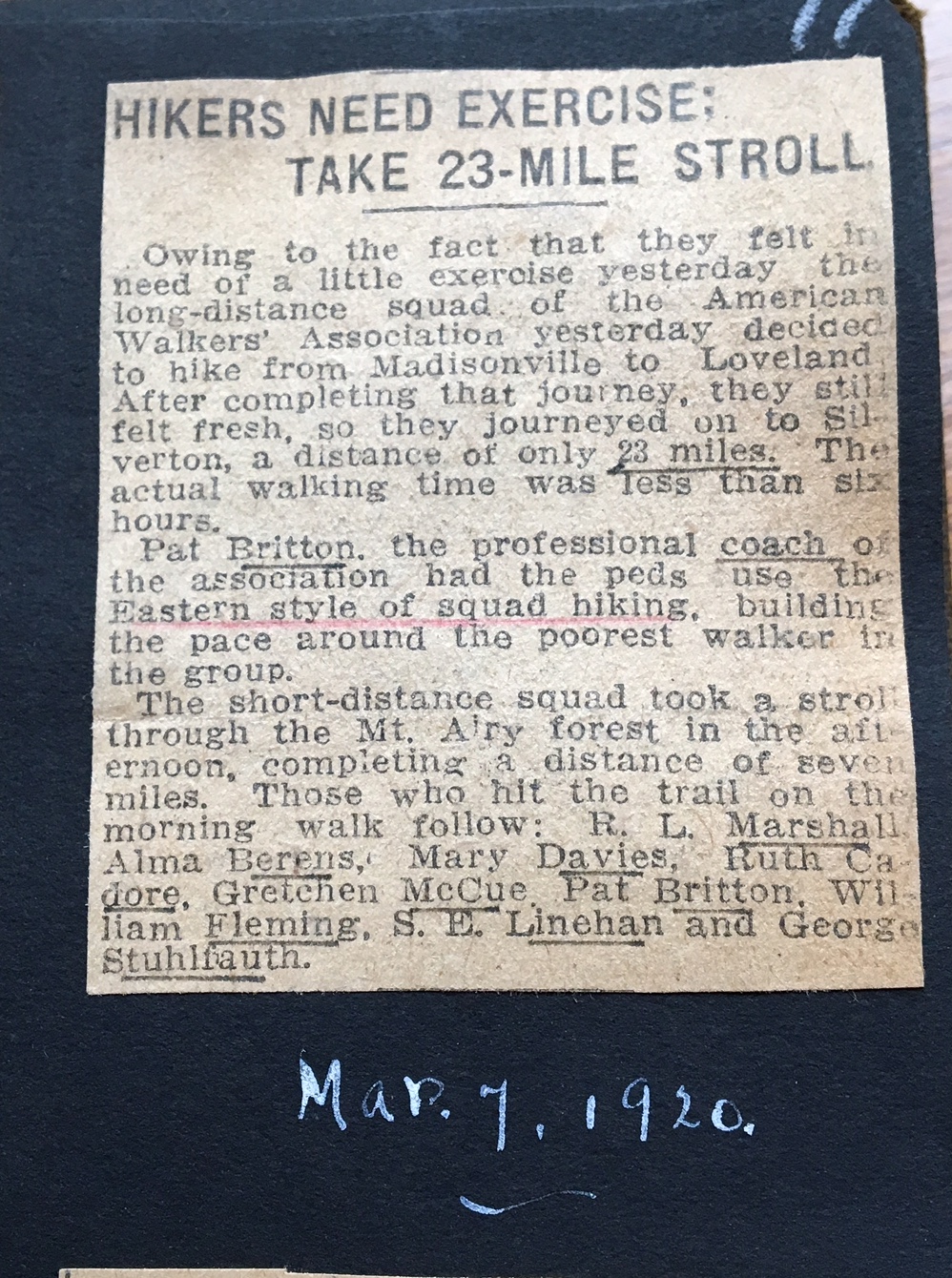
The AWA employed their own professional coach. His name was Pat Britton. One article mentions that he had the peds use the eastern style of squad hiking, which meant building the pace around the poorest walker in the group.


Irwin Carroll was another notable individual in the walking community.  He was a prominent competitor – the only individual to win the Thanksgiving Day Race both as a walker and as a runner – and hiker.  His name appears often among the weekly hiking participants.  Irwin served for many years as the president of the AWA.

Here are comments that Tom Forte had to say about Irwin (Erv) Carroll.  "Irwin Carroll lived on Robinson Road in Pleasant Ridge about a block from where I grew up with my grandparents. Mr. Carroll started the cross country and track programs at Nativity when I was about in 6th grade (early 1960s). I always finished last and to this day have my collection of rabbits feet, lucky penny horseshoe keychains, and other "trophies" he gave me for finishing. I would see him at high school, AAU, and Junior Olympic meets. What a swell guy he was."


There was mention of the 500th consecutive weekend walk by the American Walkers Association. Greater Cincinnati was known as having one of the most interesting and largest walking clubs in the US.  446 different people, many who were women, took part in their various activities.


Regular articles, describing the weather and the route, listing the participants, and mentioning other activities that they may have indulged in, appeared in the newspapers.  These other undertakings included dinners, explorations, ball games and dancing.  The accounts employed flowering language such as:
“the peds enjoying the spring-like zephyrs as they tripped merrily over the hills”
“in charge of the hipweavers”
“a real man’s sized hike”


There was even a mention about the new city of Mariemont that was in the process of being built.


Yes, it appears that walking with walking groups was a very popular activity during the 1920s.